Geometry
Vad vi kommer jobba med:
Centralt innehåll
Basic geometrical objects such as polygons, circles, spheres, cones, cylinders, pyramids, cuboids and their relationships. Basic geometrical properties of these objects.
Construction of geometrical objects. Scale and its use in everyday situations.
Comparing, estimating and measuring length, area, volume, mass, time and angles using common units of measurement. Measurements using contemporary and older methods.
How the assessment/s within the unit will be completed:
Kunskapskrav
Week 10: Lesson 1: Intro to Geometry
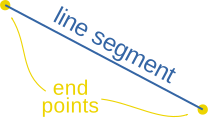
- is straight (no curves)
- has no thickness
- extends in both directions without end (infinitely)

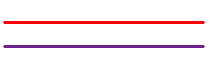
Here the red and blue lines are parallel.
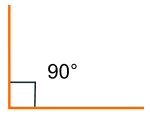
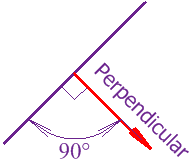 At right angles (90°) to each other.
Week 10: Lesson 2: Recognising Angles
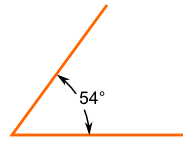
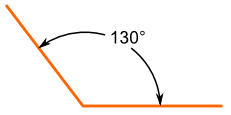
In this lesson, we will discuss three main types of angles: acute, right, and obtuse angles. Angles are measured in degrees. There are 360 degrees in a full rotation of a circle.
Week 10: Lesson 3: 2D Shapes
In this lesson, we will review the names of 2D shapes in English and Swedish. We will also discuss the properties of each shape, in order to compare them.
Week 11: Lesson 1: Measuring and Drawing Angles
In this lesson, we will review the types of angles that we learned last week. We will begin to practise measuring angles using a protractor.

Week 11: Lesson 2: Pi Day!
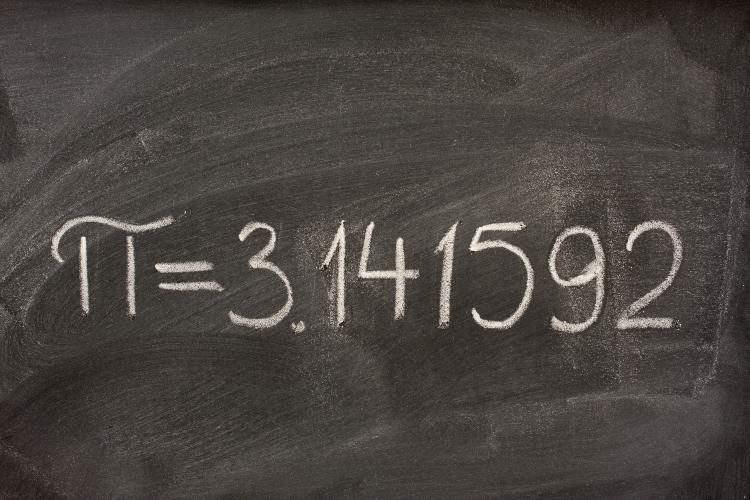
Pi Day is the official Math Holiday and it lands on March 14th every year (3.14). In this lesson, students will be taking part in a range of activities to learn about Pi.
Week 11: Lesson 3: 2D and 3D shapes
Cube = Kub Cuboid = Rätblock Sphere = Sfär eller klot Cone = Kon Cylinder = Cylinder Square Based Pyramid = Fyrsidig pyramid Triangular Prism = Prisma med triangulär bottenyta Faces = Sidoytor Edges = Kanter
Week 12: Lesson 1: Perimeter
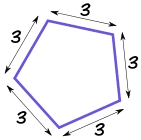
In this lesson, we will work on finding the perimeter around the outside edge of squares, rectangles, and regular shapes. Perimeter - Omkrets: the distance measured around the outside of a shape Length/Längd - longest side Example: the perimeter of this rectangle is 7+3+7+3 = 20 Example: the perimeter of this regular pentagon is 3+3+3+3+3 = 5×3 = 15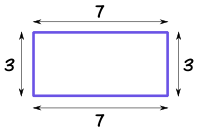
Week 12: Lesson 2: Perimeter of Compound and Irregular Shapes
In this lesson, we will discuss how to find the perimeter of compound and irregular shapes.

Week 12: Lesson 3: Recap & Consolidate
In this lesson, we will review much of the vocabulary from the last few weeks and practise solving a range of geometry problems using laptops and playing interactive games.
Week 13: Lesson 1: Introduction to Area
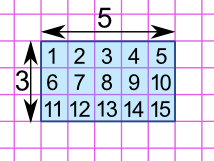
In this lesson, we will focus on calculating the area of 2D shapes by counting squares and measuring in square units.
Week 13: Lesson 2: Calculating Area using Multiplication
In this lesson we will practise calculating the area of rectangles by using multiplication.

Week 13: Lesson 3: Area of Triangles
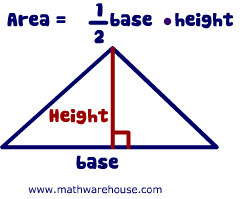
In this lesson, we will learn about the different types of triangles and how we classify them.


Week 14: Lesson 1: Area of Triangles Continued
In this lesson, we will continue to practise solving the area of triangles. We will also review the different types of triangles.
Week 14: Lesson 2: Area of Compound Shapes
In this lesson, we will discuss calculating the area of compound shapes. A compound shape is a figure made up of a range of 2D shapes.
Divide the shape into squares and rectangles, find their individual areas and then add them together.

Area = 16 + 16 + 48 = 80cm2
Week 14: Lesson 3: Area Review and Irregular Shapes
In this lesson, we will go over all of the methods for calculating area. We will discuss how to calculate the area of irregular shapes and spend time solving word problems relating to finding area.


Inte publicerad än
Inte publicerad än
Inte publicerad än
Inte publicerad än
Week 16: Lesson 2: Translations
In this lesson, we will be discussing translations of shapes. Translations are when shapes move along a coordinate grid.
The shape still looks exactly the same, just in a different place.


Week 17: Lesson 1: Reflections
In this lesson, we will reflect shapes across a mirror line on a coordinate grid.


Week 17: Lesson 1: Checkpoint Review
In this lesson, we will review all of the topics from the geometry unit to prepare for the checkpoint in Lesson 3.
Week 17: Lesson 2: Checkpoint
The checkpoint will cover these topics from the entire geometry unit:
Week 17: Lesson 3: Checkpoint Review
In this lesson, we will discuss the answers to the checkpoint and go over any areas with misconceptions. We will continue to practise sample questions for next week's assessment.
Inte publicerad än
Week 18: Lesson 1: Assessment Review
In this lesson we will review several topics. Students will be split into groups and rotate between 4 different stations in the classroom. Students may complete any unfinished work at home to help them prepare for the assessment.
Week 18: Lesson 3: Assessment
The assessment will cover the following topics: